







The LITE European project fuels the exchange of knowledge between photonics and ophthalmology
01/04/2016 ·
 Actualités
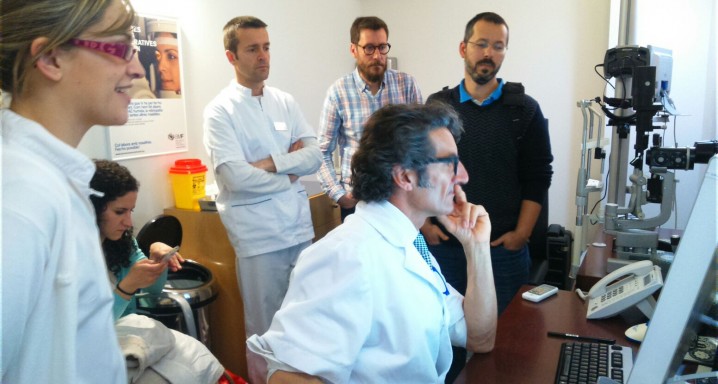
The multidisciplinary teams of the Institut de la Màcula and the Institute of Photonic Sciences (ICFO) that form part of the European project LITE (Development of Advanced Laser Imaging Techniques for the anterior and posterior Eye) have spent a day together strengthening their partnership. The meeting gave them an opportunity to exchange knowledge and share the latest developments with regard to the new technologies used at their centres.
Dr. Jordi Monés, together with other researchers from the Institut de la Màcula, explained the details of optical coherence tomography (OCT) techniques, while those from the ICFO set out the characteristics of Raman spectroscopies. Both techniques are widely used in biomedical applications and may complement each other in the study of pathologies related to the eye fundus, among others.
Optical coherence tomography (OCT) uses optical interferometry to produce non-invasive, cross-sectional, high-resolution images of the anterior and posterior segment of the eye. It has now become a highly useful tool for optometrists and ophthalmologists in the ultrastructural study of ocular anatomy.
With regard to Raman spectroscopy (RS), although this optical technique enables molecular changes to be detected with great precision, its interpretation is complex. However, in combination with Multivariate Curve Resolution (MCR), it represents a new methodology that will boost the application of RS for in vivo monitoring of biochemicals.
The meeting saw the presentation of two biomedical applications of RS that have given good results: firstly, one carried out on an eye with a retina damaged by inflammation in a multiple sclerosis patient and, secondly, the metabolic composition of cancer cells in the Epithelial to Mesenchymal transition (EMT) and in the progression of bone metastasis.
The training sessions shared by the Institut de la Màcula and the ICFO enable professionals from the two centres to acquire a wider vision of the latest technologies applied to diagnosis. They also put first-rate complementary experiences and knowledge within reach.

This project is being developed in collaboration with the ICFO – the Institute of Photonic Sciences – together with Construzione Strumenti Oftalmici (CSO), the Istituto Nazionale di Ottica (INO) and the Istituto di Fisica Applicata Nello Carrara (IFAC). It is co-financed by Acció (the Agency for Business Competitiveness) and the European Union through the Seventh Framework Programme of Research and Technological Development, specifically the BiophotonicsPlus project, which aims to promote R&D in the field of photonics.


