







Investigative Ophthalmology & Visual Science publishes an article by Dr. Jordi Monés and Dr. Marc Biarnés
05/12/2014 ·
 خبر
خبر
The scientific review Investigative Ophthalmology & Visual Science (IOVS) has published an article by Dr. Jordi Monés, MD, PhD and Dr. Marc Biarnés, MPH, PhD, both of the Institut de la Màcula, together with Dr. Carlos G. Forero, Dr. Luís Arias and Dr. Jordi Alonso.
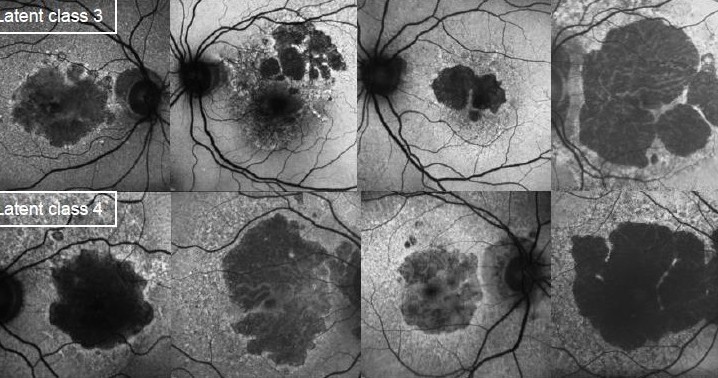
The article entitled Reappraisal of geographic atrophy patterns seen on fundus autofluorescence using a latent class analysis approach. The aim of this study was to reassess autofluorescence (AF) patterns in patients with geographic atrophy (GA) and to objectively evaluate their stability with time, through latent class analysis (LCA).
AF is an imaging technique that has been used over recent years to classify patients with GA into different patterns (phenotypes), different groups defined on the basis of the AF distribution around the areas of atrophy. The importance of this characterisation lies in the fact that these patterns (10 types) are associated with the progression of the disease, so that they have a clear predictive value. Despite all this, the classification of these patterns is complex and initially takes place subjectively.
LCA is a statistical method that connects a series of variables observed to a group of characteristics that are latent or not observed. It aims to detect the presence of underlying categories or classes from the patterns of association that are indicated by observers.
Analysis of the data obtained provided the optimum number of patterns (latent classes), which numbered five. Surprisingly, the classes showed a positive correlation with the area of atrophy.
These results imply that the autofluorescence (AF) patterns in Geographic Atrophy (GA) are not really phenotypes (intrinsic characteristics of patients), but different stages in the disease. That is, AF patterns display a stage of the disease, not a genetic or histological characteristic typical of the patient. Nevertheless, AF continues to be very useful in the assessment of these patients.
You can view the full study through this link.


