







The LITE Project places the Institut in the elite of European research
03/12/2015 ·
 Actualités
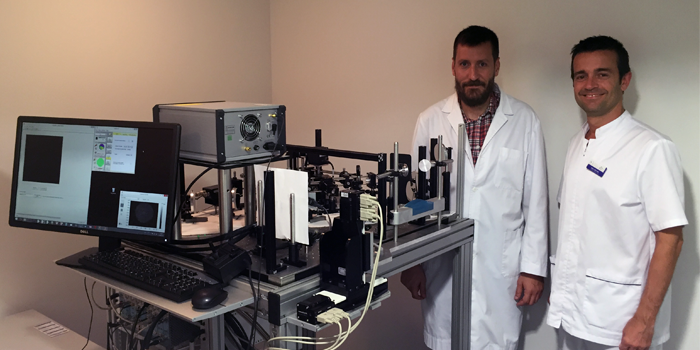
Development of Advanced Laser Imaging Techniques for the Anterior and Posterior Eye (LITE) is a project involving the creation of a hybrid system that will allow for new eye imaging techniques to treat pathologies of the retina and cornea, framed in Horizon 2020 Programme. To find out more about the project, we talked to Dr. Marc Biarnés, the Clinical Epidemiologist at the Institut de la Màcula, and Dr. David Merino, the Researcher from the Super-Resolution and Light Nanoscopy Unit of the Institute of Photonic Sciences (ICFO).
You can read the full interview in the following link.
What does the project consist of?
Marc Biarnés: LITE is an innovative international ocular research project to create an instrument that enables us to view the retina’s photoreceptors, through a technique based on adaptive optics.
David Merino: The new system, which has been developed at the ICFO, enables the taking of images of various retinal layers at different depths. These images have a resolution level that no other commercial instrument has provided up to now.

Image courtesy of SLN@ICFO.
The LITE Project will reveal new techniques and specificities in the field of eye imaging. What will these advances provide in the short and long term?
MB: The new system will give us a diagnosis that is better adjusted to the cellular level of the degenerative eye diseases causing blindness. It will also give us new, more exact parameters for assessing the effectiveness of the response to new emerging experimental therapies such as regenerative medicine treatment with stem cell implants. This is a non-invasive technique that enables simultaneous exploration of the eye’s anterior and posterior segment, thereby reducing the costs of equipment.
DM: This new imaging system will also allow us to understand eye diseases better. With this new visualisation technique using adaptive optics, we will be able to see individual retina cells. This will enable us to have live information, which was inaccessible previously.
What is the importance of the partnership between the ICFO and the Institut?
MB: The road to developing diagnosis equipment is a very long one and to do so we need great knowledge about many different fields, and the best way to obtain this is through a multidisciplinary team. We would be totally incapable of developing adaptive optics equipment and nor would they at the ICFO know the needs and the potential interest of these techniques.
DM: The strength of the partnership is that we can place at the disposal of the Institut de la Màcula a series of techniques that would be inaccessible otherwise. Thanks to these new observation techniques, we can respond to a series of questions to which research cannot respond at present.

Image courtesy of SLN@ICFO.
At present, the instrument is with the Institut de la Màcula and studies on patients have already started. What are the next steps?
MB: It is both hard and exciting to imagine the applications that may be obtained with systems like this one; it will probably help us to take a new approach to many diseases.
DM: For the near future, we have many plans to implement new imaging techniques in the system in order to generate different images while providing complementary information. As this technology is so state-of-the-art, we have a lot to cover and research.
You can read the full interview in the following link.

Dr. Biarnés (left) and Dr. Merino during the interview
This project is being developed in collaboration with the ICFO – the Institute of Photonic Sciences – together with Construzione Strumenti Oftalmici (CSO), the Istituto Nazionale di Ottica (INO) and the Istituto di Fisica Applicata Nello Carrara (IFAC). It is co-financed by Acció (the Agency for Business Competitiveness) and the European Union through the Seventh Framework Programme of Research and Technological Development, specifically the BiophotonicsPlus project, which aims to promote R&D in the field of photonics.


