







Jordi Monés opens the 4th Update on Geriatrics with an address on the impact of AMD and the progress made so far
19/02/2018 ·
 Actualités
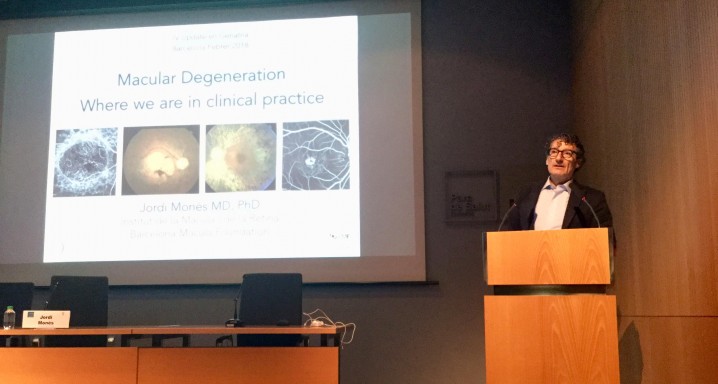
Dr. Jordi Monés, a global expert on the treatment of Age-Related Macular Degeneration (AMD), has opened the fourth edition of the Update on Geriatrics and Gerontology. At this benchmark conference in Catalonia, Dr Monés spoke of the impact of the condition on the elderly and the progress made to mitigate its effects.
Vision loss is one of the great fears when people grow old because "at that age, people desire a contemplative life: reading, seeing friends and recognising them, taking walks", Dr. Monés said. In Spain, AMD affects some 700,000 people (1.5% of the current population) and it is one of the blindness-associated pathologies that will grow the most in the coming years.
Wet AMD is the less frequent form of macular degeneration (around 15%) but scientific developments have enabled its treatment to be revolutionised. Dr. Monés stressed in his speech how important it is for health professionals to be proactive when treating the condition. It has been shown that the use of drugs on demand can cause serious flare-ups and studies indicate that the average number of intraocular injections directly into the vitreous cavity should be six in two years. At present, only half of those necessary are administered.
Meanwhile, atrophic AMD accounts for 85% of all cases and progression rates for the condition vary greatly among patients. Dr. Monés said that these people often show good visual acuity, enough to be able to see a button. However, they cannot recognise faces or watch the television. This can sometimes lead to a lack of understanding on the part of their family members.
The complexity of this form of the condition has yet to lead to the discovery of an effective treatment to halt its progression. Nevertheless, Dr. Monés acknowledged that much progress has been made and the most promising route now is through the advancements made in gene and cell therapy.


